close
Mandatory
Recommended
Other region
Not specified
plus
menu

Test method

The test specimen is placed in a vertical metal frame. A propane gas flame is applied to the test sample. The test is pursued according to a predefined scheme.
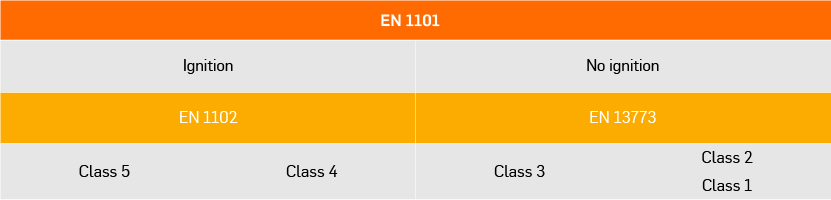
 

Test procedure scheme


EN 1101 method to determine ignitability 

A test specimen is oriented vertically on a specimen holder. A burner flame is applied to the specimen. The behavior of the fabric is observed. If ignition occurs, the ignition time is recorded. If ignition occurs, the test continues following standard EN 1102, if not, following EN 13773.


EN 1102 method to determine flame speed

The flame is applied to the test material which is hung vertically for 10 secs. The time needed to reach three defined marked points on the specimen is noted. The test material is categorized Class 4 or 5 based on the flame spread time.


EN 13773 method to measure flame spread

A heat source with defined energy is applied to the back of a vertical specimen. After exposure a small flame is applied to a piece of cotton fabric wrapped around the bottom of the specimen. Flame spread is measured by determining the time taken to reach reference points on the specimen.


Result

The test material is categorized as:

  • Class 1 to 5: Class 1 with no ignition for EN 1101 and first marker thread not reached for EN 13773; 
  • Class 2 with no ignition for EN 1101 and third marker thread not reached for EN 13773; 
  • Class 3 with no ignition for EN 1101 and third marker thread reached for EN 13773; 
  • Class 4 with ignition for EN 1101 and third marker thread not reached for EN 1102; 
  • Class 5 with ignition for EN 1101 and third marker thread reached for EN 1102.
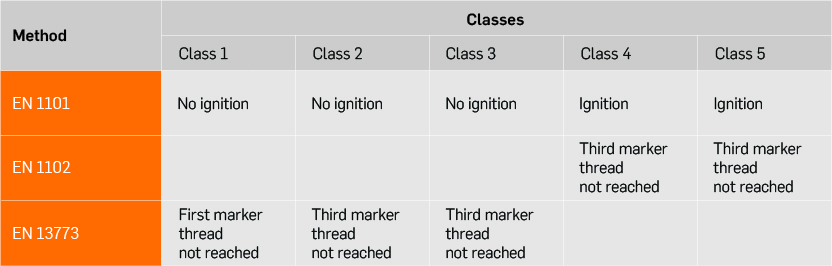
 

Test result classification


> View all fabrics complying with the European EN 13773 standard

Labotex

Labotex, our test lab for this standard

Related FR standards

American Boston BFD IX 1

A very severe vertical flame test which measures the ignition resistance of a 4" x 12" specimen when exposed to 6" propane torch flame for 10 seconds. After flame, flame propagation distance and afterglow (propagating and non-propagating) are measured.
arrow_right

American CAL 117 Sec.E Part 1 (CS191 53)

The test material is put on a chair simulation and is exposed to a burning cigarette.
arrow_right

American FMVSS 302

A flame is applied to a test specimen to determine the burning behavior of a fabric used for the interior of motor vehicles.
arrow_right

American NFPA 255 / ASTM E 84

The purpose of the test is to provide a comparative measurement of surface flame spread and smoke development of materials with that of a select grade red oak and reinforced cement board under a specific fire exposure conditions.
arrow_right

American NFPA 260A/UFAC Class 1

The test material is put on a chair simulation and is exposed to a burning cigarette.
arrow_right

American NFPA 701

A burner flame is applied to a vertically oriented textile fabric to determine the flame propagation.
arrow_right

American NY Port Authority FAR Part 25.853 1992

A vertical flame test which measures the ignition resistance of a 12" x 12" restrain specimen when subjected to 1.5" flame for 12 seconds. Char legnth, after flame and drip burn are measured.
arrow_right

Australian New Zealand AS 1530 part 2

This test is suitable for materials that don't melt or shrink.
arrow_right

Australian New Zealand AS 1530 part 3

Ignitability, flame propagation, heat release and smoke release are determined simultaneously by means of a vertical heat source.
arrow_right

Australian New Zealand AS 3744.2

An assembly of upholstered materials is subjected to a match-flame equivalent to examine its burning behavior.
arrow_right

Australian New Zealand AS NZS 4088.1

An assembly of upholstered materials is subjected to a burning cigarette to examine its burning behavior.
arrow_right

Austrian Önorm B 3825

A flame is applied to a simulated chair to assess the burning behavior of the test fabric.
arrow_right

British BS 5852 source 0, 1,5 (Cigarette, Match) and (Crib 5)

Different ignition sources are applied to a constructed test rig to examine the burning behavior of a test material.
arrow_right

British BS 5867 part 2 type B and C

A flame is applied to a vertically oriented textile fabric to determine the fire behavior.
arrow_right

British BS 7176

Specification for resistance to ignition of upholstered furniture for non-domestic seating by testing composites. This standard refers to the test standards British BS 5852 source 0, 1,5 (Cigarette, Match) and (Crib 5), BS European EN 1021 Part 1 and 2-1 or BS European EN 1021 Part 1 and 2-2, depending on the end-use environment involved.
arrow_right

Canadian CAN ULC S109

A flame is applied to a vertically oriented test fabric to determine the burning behaviour. The test provides a mean to determine the relative response to flame of fabrics under low intensities of fire exposure.
arrow_right

Chinese GB 20286

The burning behavior of fire retarding products and subassemblies in public places is assessed.
arrow_right

European EN 1021 Part 1 and 2

The test fabric is exposed to different ignition sources, namely a burning cigarette and butane flame, to examine its burning behavior.
arrow_right

French NF P92-503,504,505 507 (M1)

Electrical burner test (for 503), complementary rate of flame spread test (for 504) and dripping test (for 505).
arrow_right

German DIN 4102 (B1)

For German DIN 4102 (B1), a material is classified as B1 if it fulfils the requirements of a B2-test and the ‘fire shaft’ test.
arrow_right

IMO FTPC P7 Textiles and Films Fire Test Marine Equipment

A specimen of the fabric for maritime use to be tested is oriented vertically. A flame is applied to it to determine the burning behaviour.

arrow_right

IMO FTPC P8 Upholstered Furniture Fire Test to Marine Equipment

An assembly of upholstery materials for maritime use is subjected to 2 ignition sources: a smoldering cigarette and a flaming source equivalent to a burning match.
arrow_right

Italian UNI 9175 (Classe Uno)

The combustion of upholstered furniture is evaluated in presence of or without flame and/or glow. This gives an indication of the reaction to fire of furniture exposed to a small ignition source.
arrow_right

Japanese JIS L1091

A specimen is subjected to a flame under different conditions. Its burning behavior is observed.
arrow_right

Swiss SNV 198898

The flammability and smoke density are determined, respectively according to SN 198'898 and VKF. The first determines the burning behavior of a vertically oriented fabric, the latter assesses the smoke development of a fabric that is completely burnt down in a test chamber.
arrow_right

Taiwanese CNS 10285 L3196

The flame retardancy properties of thin building materials, thin plywoods and textile products are tested.
arrow_right
European EN 13773
Drapery
METHOD OF TESTING
A flame is applied to a vertically oriented test fabric to determine the burning behavior.
European EN 13773