A specimen of the fabric for maritime use to be tested is oriented vertically. A flame is applied to it to determine the burning behaviour.
Test method
The test specimen is placed in a vertical metal frame. A flame is applied to the surface and to the bottom edge of a test sample. It is observed whether ignition occurs. After flame time, burn-through to the edges, burning droplets (by means of a cotton wool pad), the charred length and the possibility of surface flash are observed.
Part 7: test for vertically supported textiles and films - reference standard
This includes: IMO Res. A563 (14) - amendments to the recommendation on test method for determining the resistance to flame of vertically supported textiles and films; IMO Res. A471 (XII) - recommendation on test method for determining the resistance to flame of vertically supported textiles films.
Part 8: test for upholstered furniture
This includes: IMO Res. A652 (16): test for upholstered furniture smouldering cigarette test and butane flame test.
Result
The test material passes the test if it shows following characteristics: - after-flame time maximum 5 seconds; - no burn-through to any edges; - no ignition of the cotton wool pad; - average char length maximum 150 mm; - no occurrence of a surface flash propagating more than 100 mm.
Additional information
On 5th December 1996 IMO/MED introduced under MSC. 61(67) a new International Code for application of Fire test procedures to be implemented on 1st January 2010. The new code is named IMO FTPC (short for Fire Test Procedure Code). The required tests are listed under those Fire Test Procedure Codes:
- Part 1: Non-combustibility test;
- Part 2: Smoke and toxicity test;
- Part 3: Test for “A”, “B” and “F” class divisions;
- Part 4: Test for fire door control systems;
- Part 5: Test for surface flammability (test for surface materials and primary deck coverings);
- Part 7: Test for vertically supported textiles and films;
- Part 8: Test for upholstered furniture;
- Part 9: Test for bedding components;
- Part 10: Test for fire-restricting materials for high-speed craft;
- Part 11: Test for fire-resisting divisions of high-speed craft;
- Annex 2 Products which may be installed without testing and/or approval;
- Annex 3 Fire protection materials and required approval test methods;
- Annex 4 SOLAS, chapter II-2, regulation 5.3 and 6.2, (MSC/Cir.1120).
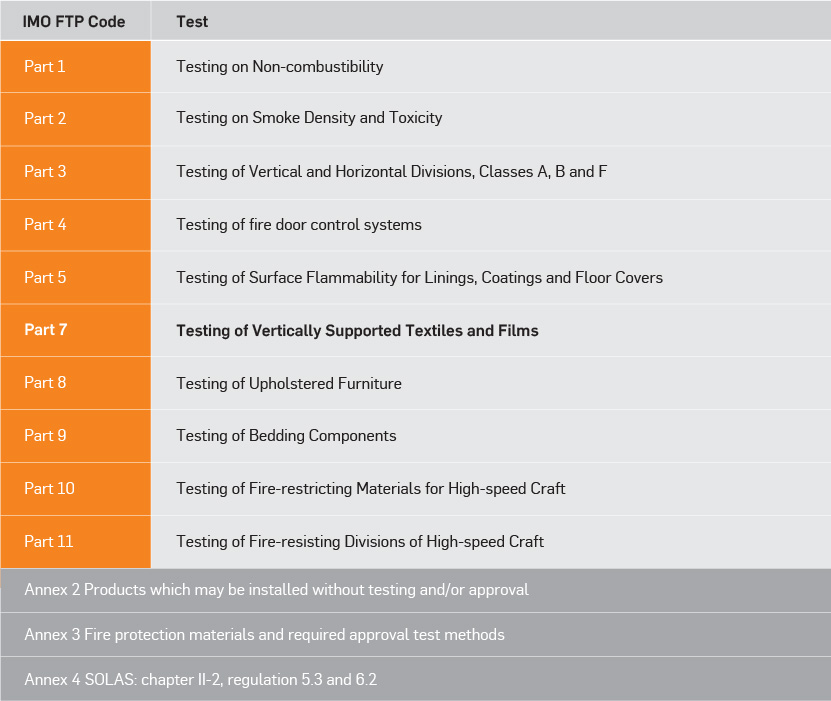
IMO Fire Test Procedure Codes(FTPC)
> View all fabrics complying with the IMO FTPC P7 drapery standard
Related FR standards
American Boston BFD IX 1
American CAL 117 Sec.E Part 1 (CS191 53)
American FMVSS 302
American NFPA 255 / ASTM E 84
American NFPA 260A/UFAC Class 1
American NFPA 701
American NY Port Authority FAR Part 25.853 1992
Australian New Zealand AS 1530 part 2
Australian New Zealand AS 1530 part 3
Australian New Zealand AS 3744.2
Australian New Zealand AS NZS 4088.1
Austrian Önorm B 3825
British BS 5852 source 0, 1,5 (Cigarette, Match) and (Crib 5)
British BS 5867 part 2 type B and C
British BS 7176
Canadian CAN ULC S109
Chinese GB 20286
European EN 1021 Part 1 and 2
European EN 13773
French NF P92-503,504,505 507 (M1)
German DIN 4102 (B1)
IMO FTPC P8 Upholstered Furniture Fire Test to Marine Equipment
Italian UNI 9175 (Classe Uno)
Japanese JIS L1091
Swiss SNV 198898
Taiwanese CNS 10285 L3196

Labotex, our test lab for this standard
- Satenrozen 2A, 2550 Kontich, BELGIUM
- +32 3 451 8000
- www.labo-tex.com